On this page
Three views answer three different questions
The History area keeps three records side by side:
- Raw timeline: the measurements and state changes Perstat observed
- Curated outage record: the outages and exclusions your team reviews
- Configuration activity: the organizational changes and the person responsible for each
Because the records stay separate, a corrected outage leaves the raw measurement in place. A configuration change does not appear as an external failure.
Measured downtime and curated downtime stay distinct
When an operator discards a false positive, Perstat previews the uptime effect and requires a reason. The exclusion records the actor and can be reversed. Its window runs from the last good check before the rejected event to the first good check after it.
The measured event and the decision about how it counts stay reviewable as separate facts. This is a curation path, not silent deletion.
Maintenance and incidents use explicit boundaries
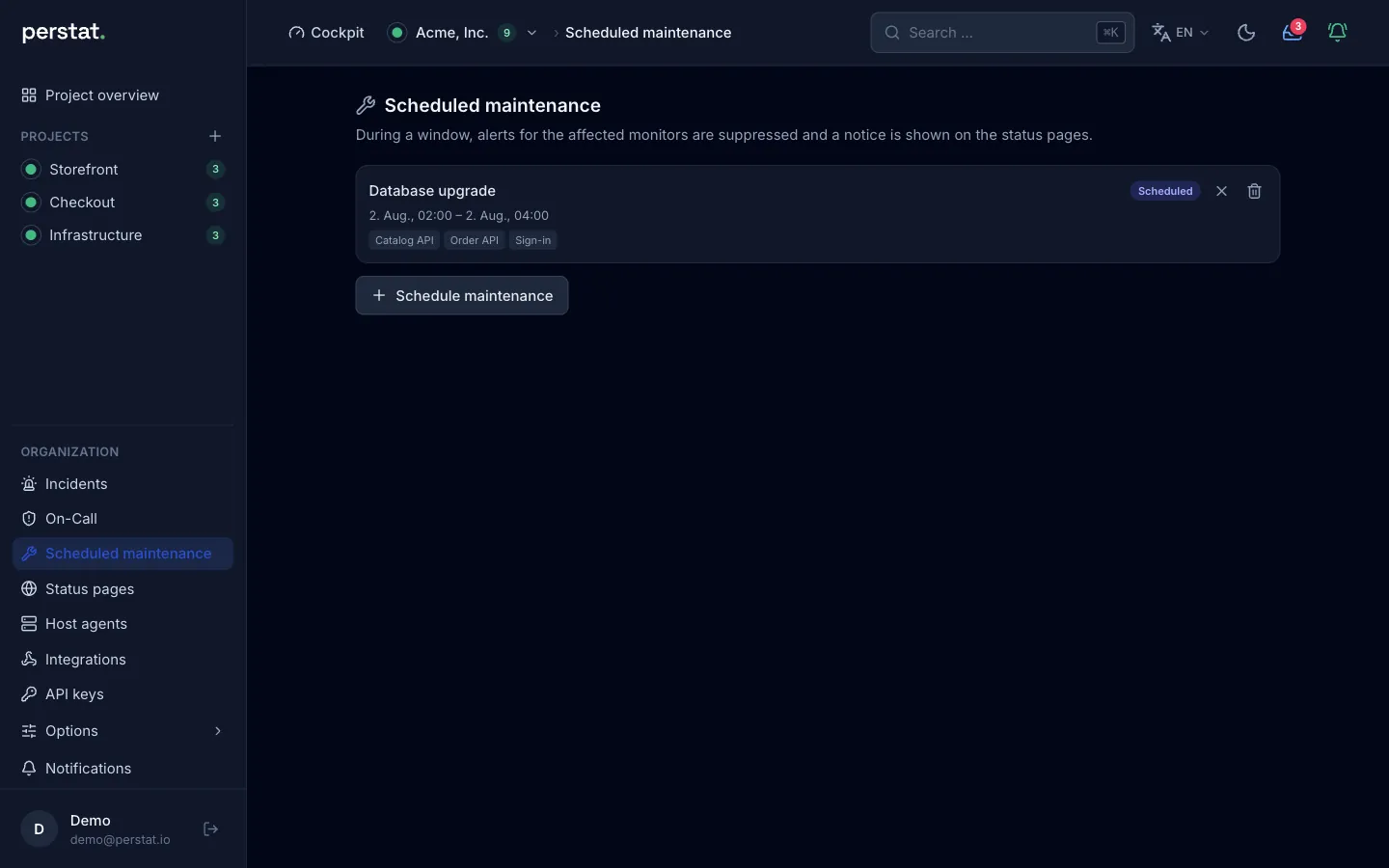
A scheduled maintenance window suppresses new incidents, remains in the record, and is excluded from uptime. For a regional probe monitor, an automatic incident runs from quorum confirmation until the recovery quorum. Agent and heartbeat monitors follow their direct signal rules instead of regional quorum.
The calculation exists behind an authenticated session
Perstat calculates a monitor-specific SLA result from incidents, maintenance, and exclusion windows. The evidence documentation describes the calculation and its input boundaries.
Today that result is technical JSON behind an authenticated browser session. It is not a public API. Each monitor view offers a PDF report for 7, 14, 30, or 90 days on every plan. The report is not signed or certified.
The public report is an editorial sample
The sample SLA report is public, and its figures can be recomputed. It is an editorial example of the structure. It is not a generated customer report. The PDF report in the monitor view is the generated one.
Published plan windows and exit
| Plan | Plan window (days) |
|---|---|
| Free | 7 |
| Pulse | 30 |
| Sentinel | 90 |
| Command | 365 |
| Enterprise | 730 |
These published plan windows do not yet define the deletion period for every stored object. Retention for raw checks, agent samples, daily rollups, and incident artifacts is being reconciled with these windows and the current 13-month Terms wording. Confirm the applicable retention terms through security before procurement or deployment.
Perstat currently provides an organization export manually on request. It is an exit path, not a self-service download, and the PDF report per monitor does not replace it. The export contains CSV files plus a manifest for:
- monitors
- measurements
- states
- monitor-linked incidents
- windows
Limits of the record
Perstat describes changes as attributed, reasoned, and reversible. It does not describe the overall store as tamper-proof, immutable, or write-once. It does not claim that the record alone is enough for an organization to meet the requirements of DORA, NIS2, or any other framework.
Inspect the editorial sample, request the documented export through security, or start building the record with one free monitor.