On this page
Assert the content your checkout returns
An uptime tool that only checks whether your homepage returns 200 is watching the wrong thing. On a sale day, the homepage can be fine while the checkout hangs or the payment redirect times out.
A cached error page can also answer 200 in place of the real cart. The checkout is the request you lose money on.
Perstat’s HTTP checks assert content, not only status. Point a check at your checkout page or a health endpoint your app exposes, and assert a string expected in the response. The string can be the order-summary heading, the payment-form field name, or a price in the right format.
A soft failure, such as a maintenance splash or a CDN error page, fails the assertion even when it returns 200. An assertion failure is a monitor result. For supported regional probe checks, the configured alert policy then decides whether that result opens an incident.
Status-code, keyword, and regex assertions are all available. A check follows up to 5 redirect hops, enough for the http-to-https-to-geo chain in front of most checkouts. The check-type reference lists all 13 types.
Perstat does not walk a test order through payment.
Watch the certificate and the domain registration
Two of the fastest ways to take an entire store offline have nothing to do with your code. An expired TLS certificate on the checkout host is a hard outage. Every current browser blocks the page with a full-screen warning, and the shopper is gone.
A lapsed domain registration is worse, because the whole store resolves to nothing.
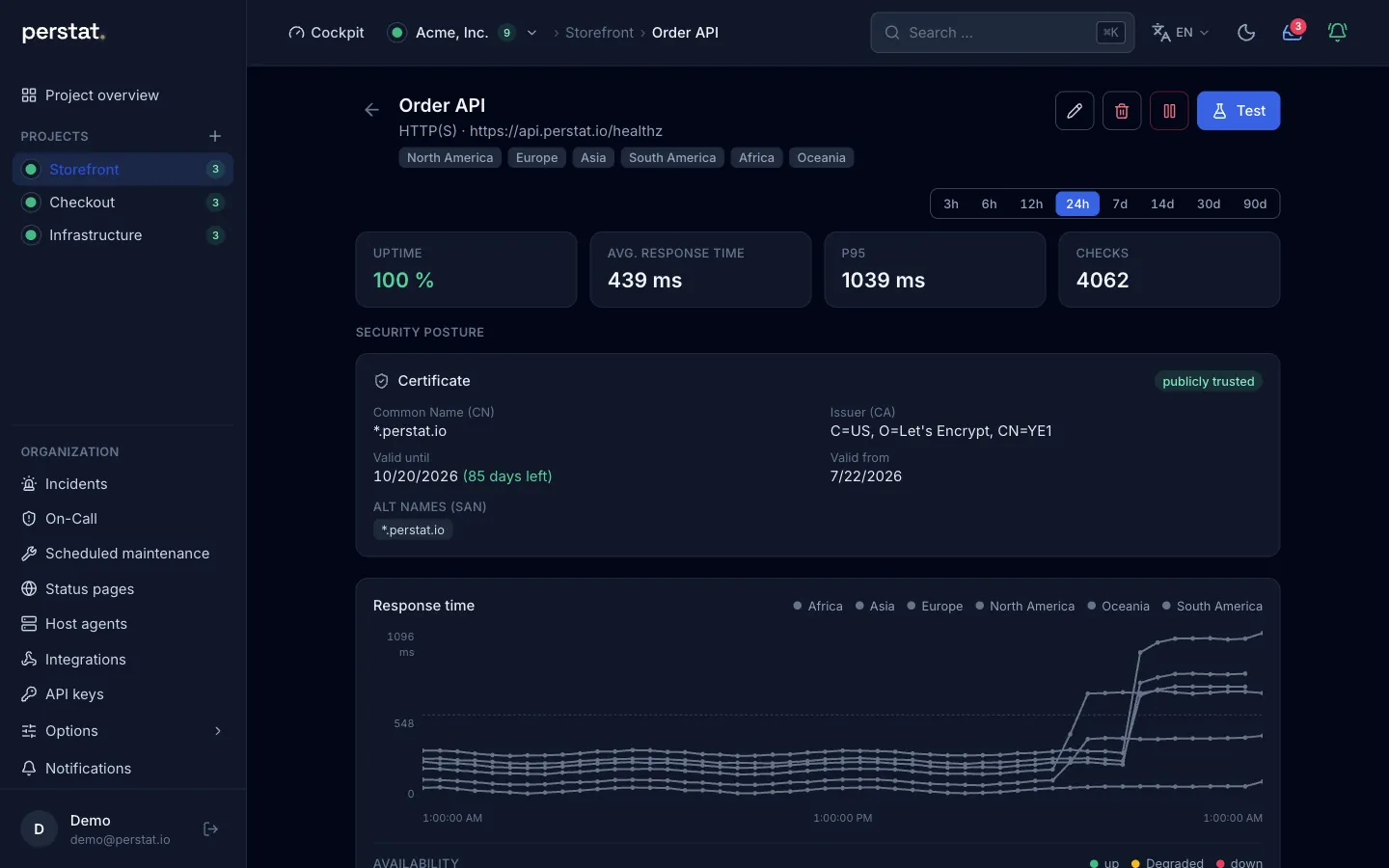
Perstat watches both. The TLS certificate check reports days to expiry, checks the issuer against what you expect, and flags a self-signed certificate. It runs inline on the same monitor as the HTTP check, so a renewal that quietly failed does not wait for a customer to find it.
The domain check watches the registration expiry (WHOIS), the nameservers, and DNSSEC.
Receipts and order confirmations may leave from your own mail domain. The SMTP check shows when that path breaks. The DNS hygiene check shows weak or missing SPF, DMARC, and CAA records. You see it before a buyer notices the confirmation never arrived.
Separate a traffic spike from an outage
In retail, your best moment and your worst moment look alike from the outside. When a sale opens, latency climbs, a transit link saturates, and one probe path slows down.
A naive monitor reads all of it as down. Your team then chases an alert that a single region invented, instead of watching real customer impact.
For supported probe checks, the plan selects 2, 3, or up to 6 regions. The standard policy opens an incident after 2 region votes, and alert profiles can change that policy. Sub-quorum divergence, such as one region drifting, remains visible on the watchlist.
Agent and heartbeat checks do not use regional quorum. The network page documents the current topology.
The plan sets the shortest interval. The web form offers 30 seconds and longer. On Command and Enterprise, you set 15 or 10 seconds through MCP.
| Plan | Shortest interval |
|---|---|
| Free | 300 s |
| Pulse | 60 s |
| Sentinel | 30 s |
| Command | 15 s |
| Enterprise | 10 s |
Tell buyers before they open a ticket
When checkout is degraded, the support queue fills in minutes. Every unanswered buyer is a refund request or a lost order. A status page on your own domain gets ahead of that.
Publish it at status.yourstore.example and let buyers subscribe with a confirmed double opt-in. Each subscriber gets one mail when you open an incident and another when it recovers, instead of guessing whether the problem is them or you. Subscribers and custom domains start with Sentinel.
A maintenance window for a deploy or a pre-sale change is announced on the page and suppresses alerts for its duration. It stays SLA-neutral, so a release you scheduled does not dent the availability number you report later.
Hand partners a record they can recompute
If you sell through a marketplace or answer to a payment provider, someone will ask for your uptime. Perstat keeps one curated record. An incident runs from quorum confirmation to confirmed recovery.
A false positive can be excluded with a logged, reversible reason, and its uptime effect is previewed first. The public, editorial sample SLA report demonstrates the calculation.
Each monitor view offers a PDF report for 7, 14, 30, or 90 days on every plan. The report is not signed or certified. Organization data can be prepared manually as CSV files with a manifest on request.
Limits
Perstat evaluates one configured request and its response. It does not run a browser journey, add an item to a cart, or complete a payment.
The published history window depends on the plan and is not a complete object-level deletion schedule.
Perstat is not APM and not real-user monitoring. It will not tell you your cart-abandonment rate, your conversion, or which query slowed a page down. For funnel and performance analytics, keep the tool built for that.
Perstat watches whether each surface a shopper touches is answering. It does so from outside, on your interval, and proves what it saw.
Start with the checkout URL
Point one monitor at your checkout page and assert a string expected in the response. Add the TLS certificate on the same host, and inspect the first results before you add more checks.
Start monitoring free without a card, or take the product tour without signing up. See pricing: Pulse €29, Sentinel €89, Command €249, and Enterprise from €690 per month. Prices are net and exclude VAT.